Friend and Foe
The story
King Shrenika of Magadha is out on a pleasure trip when he finds a young monk sitting under a tree. He asks why someone so young gave up the world. The monk says he had no protector. The king laughs and offers to be one, and the monk tells him the king has no protector either. He explains that an illness no doctor could cure left him when he vowed to renounce, and that since then he has been his own protector.
Uttarādhyayana Sūtra, Lecture 20 ("The Great Duty of the Nirgranthas"), verse 37; tr. Hermann Jacobi, Sacred Books of the East 45 (1895), p. 104
The same moment, today
A bicycle gets a flat tire three blocks from the office on a rainy morning. The rider kicks the tire and curses the city for the potholes. Then he blames his boss for calling an early meeting. But neither the city nor the boss pumped up an old, cracked tire before leaving home. The rider did that himself. Most bad days don't start with bad luck. They start with small choices we made when we weren't paying attention.
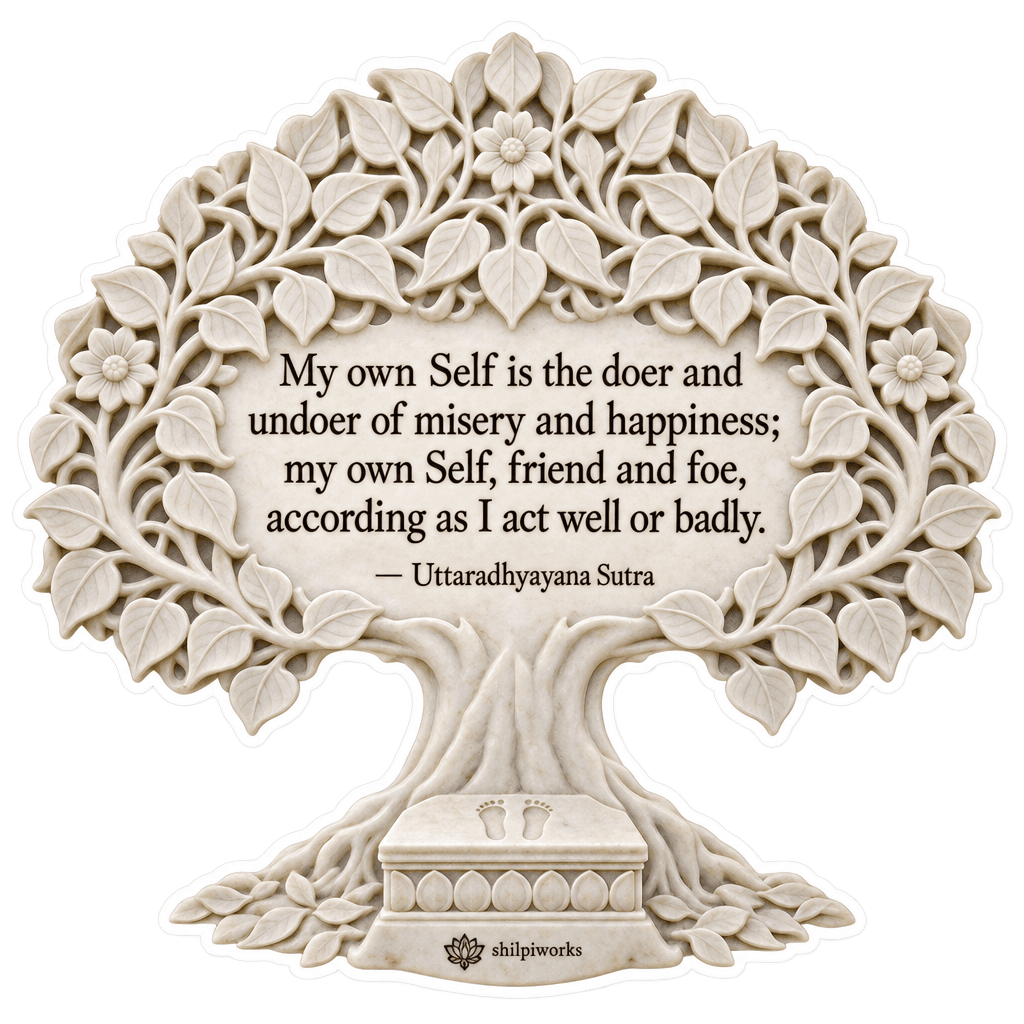
When the young monk tells the king that no one can protect him, he's describing how karma works. In Jain thought, karma isn't fate or divine punishment. It's a fine matter that binds to your soul whenever you act with anger, greed, or carelessness. Nobody else can bind it to you, and no outside savior can peel it away. You make yourself miserable when you act badly, and you bring yourself peace when you act well. During the festival of Paryushan, Jains fast and ask everyone they know for forgiveness, because nobody else can clear their ledger.
The lesson
The next time something goes wrong, stop looking for someone to blame. Look at your own choices first, because that's the only place you can fix it.
Where this comes from
Hermann Jacobi, 1895
In 1895, the German scholar Hermann Jacobi published his English translation of the Uttaradhyayana Sutra in Oxford for the Sacred Books of the East series. This text belongs to the Svetambara canon, which holds that these verses were Mahavira's final sermon. Digambara Jains don't accept the book as scripture, because they believe the earliest texts were lost, but they hold the exact same view on karma. The dialogue Jacobi translated took place in a park outside Rajagriha, where King Shrenika ruled Magadha in the sixth century BCE.
A small reminder, on your notebook or your laptop lid, that nobody else creates your troubles, and nobody else can give you peace.
$3.50
2.5 inches vinyl · weatherproof · ships in 1–3 days
Mix & save: 3 for $9 · 5 for $14 · 10 for $25· free shipping at ten
- Weatherproof vinyl
- Ships from Wayzata in 1–3 business days
- Secure checkout
If anything is wrong, we'll refund or replace it. Read the policy
Related patterns

pairs with
Soul Companion Jain Wisdom
Another early scripture that says help doesn't come from outside.

extends to
Uttaradhyayana Sutra Jain Self Mastery Manuscript
What King Nami says about mastering yourself before facing enemies.
contrasts with
Jain Mutual Service Quote
How souls can still help each other while bearing their own karma.