Souls Serve One Another
The story
The fifth chapter of the Tattvartha Sutra lists the kinds of things that make up the world and the service each one gives. Motion, rest, space, matter and time each get theirs. When it reaches souls, the service it names is that they support one another. In the 1970s, for the 2,500th anniversary of Mahavira's death, Jains of every tradition put these words at the foot of the Jain emblem as its motto.
परस्परोपग्रहो जीवानाम्
parasparopagraho jīvānām
Tattvārtha Sūtra 5.21 (the same number in both recensions); our translation
The same moment, today
A stranger holds the elevator door with one foot while you hurry down the hallway with your arms full of heavy grocery bags. You step inside, catch your breath, and say thanks. Five minutes later, you hold the heavy front gate open for an older neighbor who's wheeling a folding cart full of mail. You didn't plan it out in advance, and neither did she. It's just the quiet way people keep each other moving through the day.
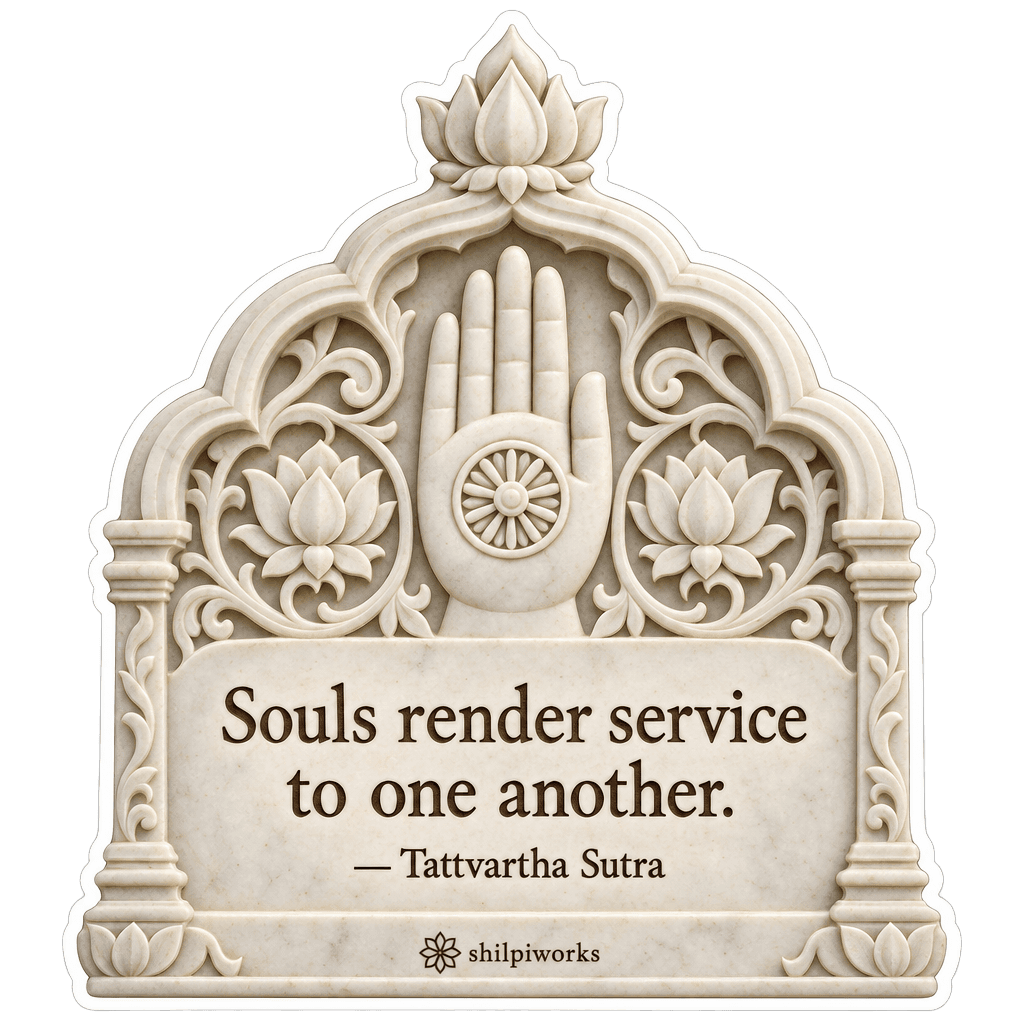
The fifth chapter of the Tattvartha Sutra treats this kind of help as basic physics. It lists the parts of the world one by one, and it names the function of each part. Space makes room for things, matter gives us bodies, time marks change, and souls support one another. It isn't just an ideal for good days. The text describes it as the basic job living things do for each other. People often translate the line as "Live and let live," but that's almost the opposite idea. Leaving someone alone is detachment, while this sutra says living things actively carry each other along.
The lesson
Notice three people who made your morning possible today, and notice who needed your help to finish theirs. You aren't standing on your own, and you never were.
Where this comes from
A motto for every tradition
The Tattvartha Sutra was composed in Sanskrit between the second and fifth centuries. It's the one doctrinal book that both the Digambara and Svetambara traditions accept as authoritative scripture. The line itself is just four words: parasparopagraho jivanam. The oldest Digambara commentary, Pujyapada's Sarvarthasiddhi, explains it through daily bonds like teacher and pupil or master and servant, where each side helps the other thrive. In 1974, all Jain sects agreed to place this verse at the base of the unified Jain emblem to mark the 2,500th anniversary of Mahavira's nirvana. The words here are our own plain translation directly from the Sanskrit.
A small reminder, on your laptop or your notebook, that living things aren't solitary islands, but a shared network holding each other up.
$3.50
2.5 inches vinyl · indoor use · ships in 1–3 days
Mix & save: 3 for $9 · 5 for $14 · 10 for $25· free shipping at ten
- For indoor use
- Ships from Wayzata in 1–3 business days
- Secure checkout
If anything is wrong, we'll refund or replace it. Read the policy
The artwork is made with AI image tools, by agents we design and check. Each sticker is then printed on vinyl and die-cut to order.