Comparative Advantage
You and a neighbor spend Saturday fixing a room. A strip of painter's tape runs down the middle. You can hang shelves and paint, and he can too. You are faster at both, but you are much faster with a hammer than a brush. He is slower overall, but the gap is smaller when he paints. So you hang every frame and he paints every wall. The arrows of work start crossing the tape. By dinner the room has more hung work and a cleaner finish than if either of you split tasks.
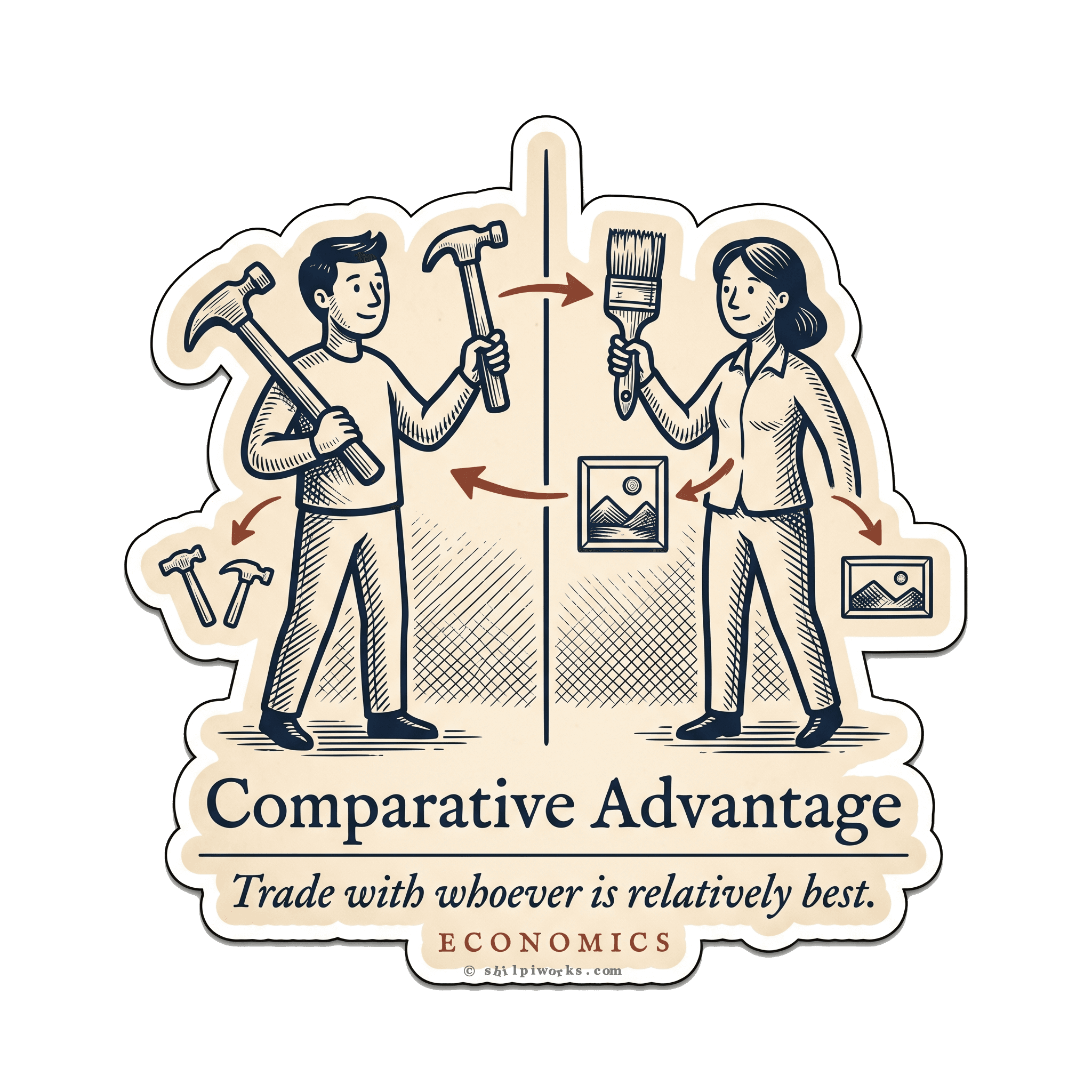
Comparative advantage is choosing jobs by what you give up to do them. Even if you are the best at both tasks, you still gain by focusing on the one where your edge is biggest and trading for the other. The other person does the reverse. Each hour goes to the task where it produces the most. That is why families, teams, and countries end up with more when they specialize and exchange.
Therefore
When you divide work or choose suppliers, ask who gives up less by doing this. Specialize on that, trade for the rest, and you both get more.
Ricardo, 1817
In 1817, the London stockbroker David Ricardo tried to explain why England and Portugal kept trading cloth and wine. Portugal could make both with fewer hours than England. Still, Ricardo showed, England should put its hours into cloth, where its disadvantage was smallest, and buy wine from Portugal, where its disadvantage was largest. He laid out simple numbers that made the point impossible to miss. Specialize by relative skill, ship the surplus, and both nations drink more wine and wear more cloth than if each tried to do everything alone.
A small reminder, on a team board or a kitchen calendar, that you win more when you focus on your edge and trade for the rest.
$3.50
2.5 inches vinyl · weatherproof · ships in 1–3 days
Mix & save: 3 for $9 · 5 for $14 · 10 for $25· free shipping at ten
- Weatherproof vinyl
- Ships from Wayzata in 1–3 business days
- Secure checkout
If anything is wrong, we'll refund or replace it. Read the policy
Related patterns

pairs with
Opportunity Cost Decision Path
Comparative advantage rests on what you give up.
contrasts with
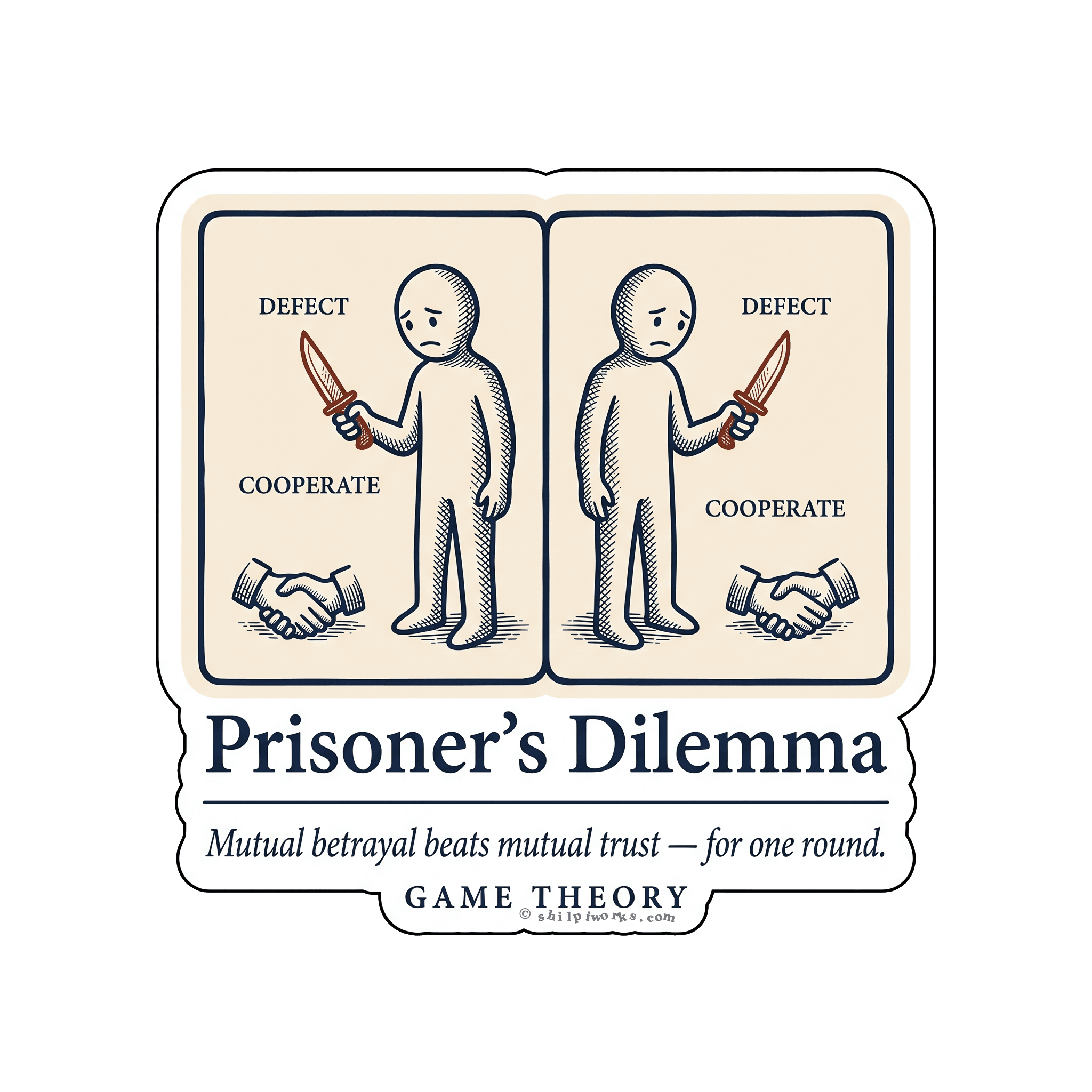
Prisoner's Dilemma Game Theory Concept
Trade gains need trust; one-off games push defection.

extends to
Creative Destruction: The Cycle of Innovation
Specialization shifts as new methods replace old ones.