To All Life Is Dear
The story
The lesson begins with pride of birth and then turns to people attached to fields, houses, jewels and gold. Just before this line it says that nothing is out of death's reach. Just after it, a man's savings are split by his heirs, stolen, or taken by the king. The teaching is passed on by Sudharman, one of Mahavira's chief disciples, who closes with "Thus I say."
Ācārāṅga Sūtra, Book I, Lecture 2, Lesson 3, §4; tr. Hermann Jacobi, Sacred Books of the East 22 (1884), p. 19
The same moment, today
An earthworm wriggles across wet concrete after an early morning rain. Most people hurry past on their way to work. Some walk right over it without noticing, but someone stops and nudges it back into the damp grass with a dry leaf. That tiny creature doesn't know anything about human schedules or cities. It's just trying to stay alive, and dry pavement will kill it within an hour.

The passage comes right after a reminder that death reaches everyone, and no hoarded gold can stop it. The text points out something simple: every creature loves its own life and hates pain. It doesn't matter whether a being has two legs, six legs, or no legs at all. That's why Jain monks carry a soft whisk broom to brush bugs off their path before they walk. It's also why many Jains filter their drinking water and don't eat after dark. The rule asks people to see every living creature as another self.
The lesson
Before you swat a bug or step carelessly, pause for a second. That life matters to them just as much as yours matters to you.
Where this comes from
Hermann Jacobi, 1884
The Acaranga Sutra is the oldest surviving book in the Svetambara canon. It was written in an early Prakrit dialect, and Book One contains its most ancient verses. Digambara Jains don't accept this book as scripture, because they hold that the original canon was lost long ago, but they live by this exact same rule of non-violence. The German scholar Hermann Jacobi published the first complete English translation of the text in Oxford in 1884. He noted an older reading of this line that translates simply as, "All beings are fond of themselves."
A small reminder, on a notebook or a desk, that every creature loves its life just as much as you love yours.
$3.50
2.5 inches vinyl · weatherproof · ships in 1–3 days
Mix & save: 3 for $9 · 5 for $14 · 10 for $25· free shipping at ten
- Weatherproof vinyl
- Ships from Wayzata in 1–3 business days
- Secure checkout
If anything is wrong, we'll refund or replace it. Read the policy
Related patterns

pairs with
Ahimsa Universal Soul Quote
The practical rule that follows from recognizing that life is dear.

extends to
Quintessence of Wisdom Ahimsa Quote
How treating every creature like yourself becomes the core of wisdom.
contrasts with
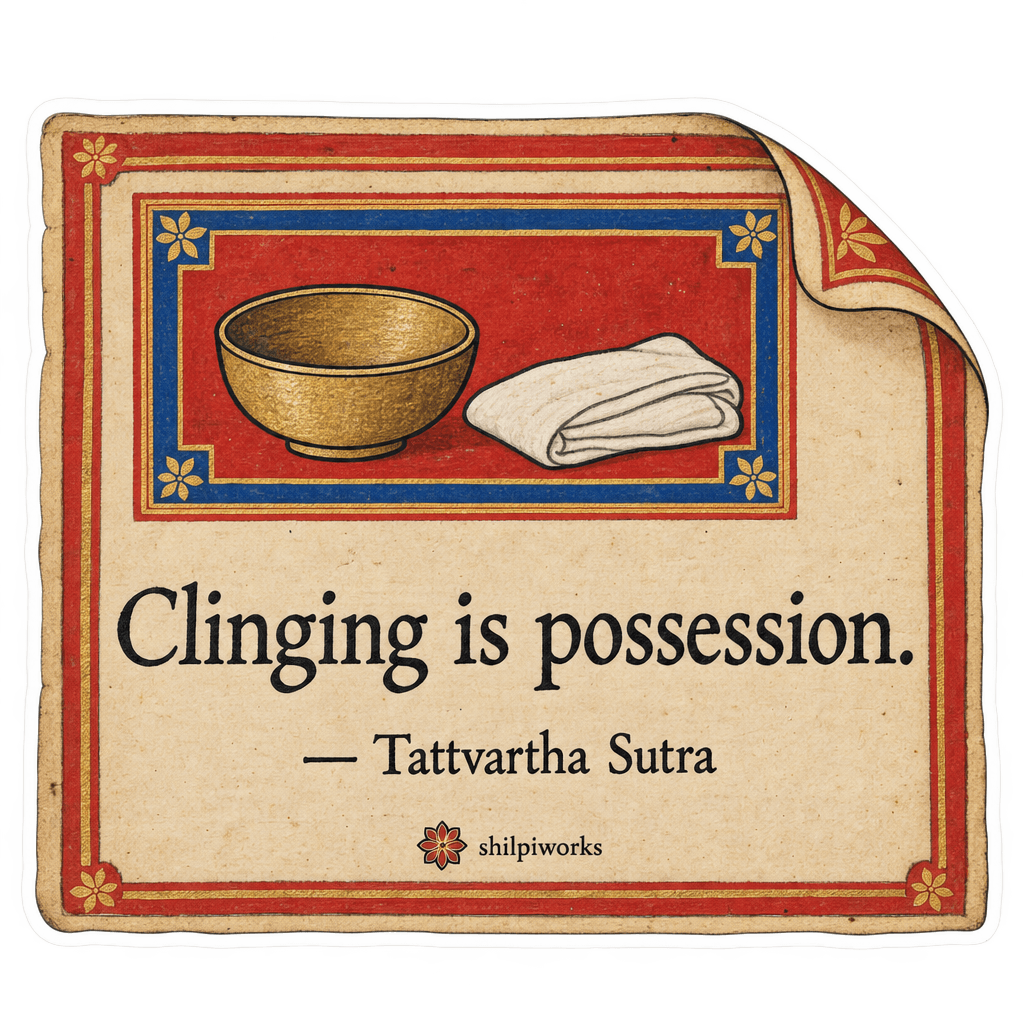
Essence of Aparigraha Quote
The greed for property that blinds people to the lives around them.