We Who Call Nothing Our Own
The story
This comes from the same test of King Nami. Indra, still in disguise, cries that the palace is on fire and asks why the king does not go back to look after his household. Nami has already given up his city, his army and his family. He answers that nothing burning there is his.
Uttarādhyayana Sūtra, Lecture 9 ("The Pravragyâ of King Nami"), verse 14; tr. Hermann Jacobi, Sacred Books of the East 45 (1895), p. 37
The same moment, today
A commuter steps off an evening train and forgets a cheap umbrella in the overhead rack. At first, they feel a quick sting of frustration. They walk three blocks through a light mist, and then their shoulders relax. They don't have to carry it anymore. They don't have to shake the water off before walking into a store. Someone else will pick it up tomorrow, or the cleaning crew will take it to lost and found. The headache of keeping track of it is simply gone.
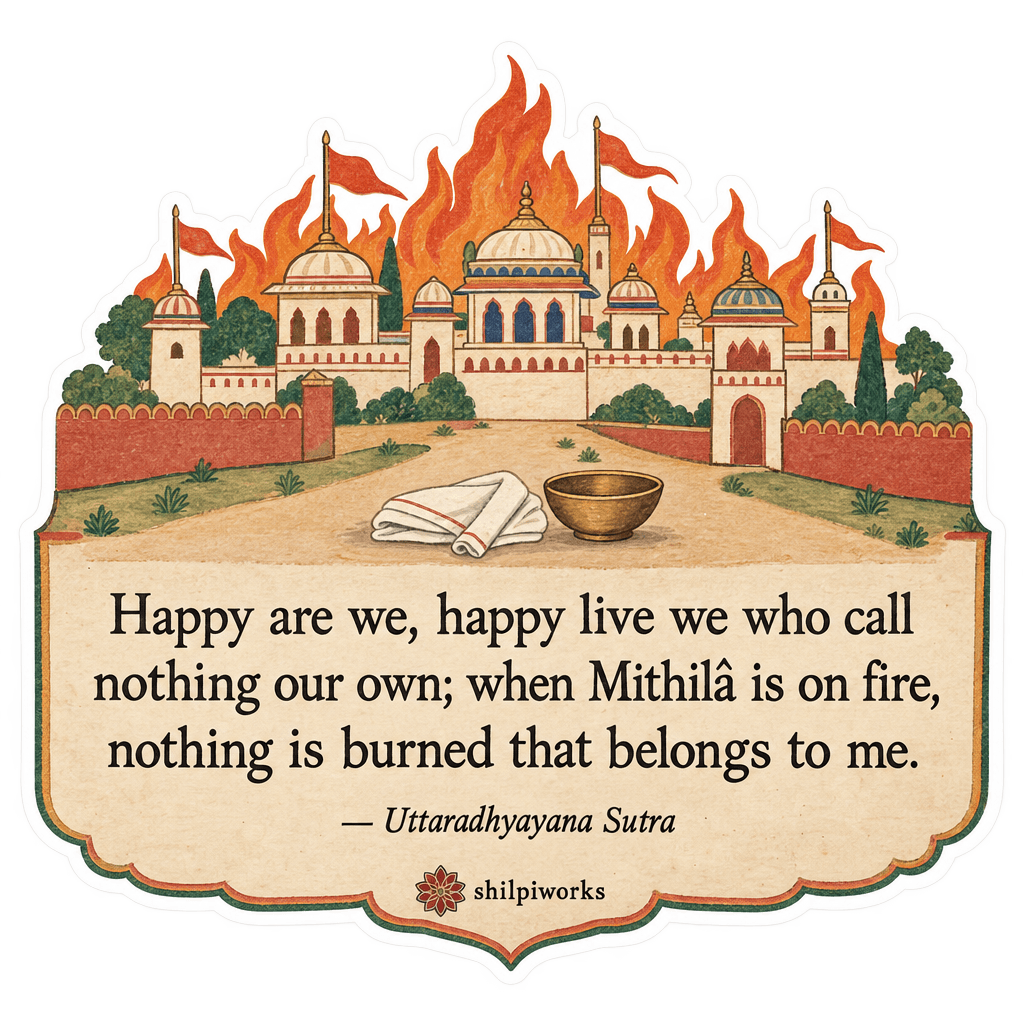
When Nami hears that the capital is burning, the fire can't hurt him because he doesn't hold on to anything in it. Jains call this practice aparigraha, or non-possession. Most people think possession is just the stuff in a closet, but the real trap is the grip in your mind. If you claim a thing as yours, its danger becomes your danger. Svetambara monks keep only three white cloths, an alms bowl, and a small whisk broom to gently clear bugs from their path. Because they don't claim the city, the city's destruction leaves their peace untouched.
The lesson
Look around your room and find one item you'd panic over if it broke. Notice that the worry doesn't come from the object itself, but from calling it yours.
Where this comes from
Hermann Jacobi, 1895
Hermann Jacobi translated this verse in 1895 for the Sacred Books of the East series. The line comes from the Uttaradhyayana Sutra, which Svetambara Jains count as part of their sacred canon. Monks read and explain it during Paryushan, their annual eight-day festival of fasting and reflection. Digambara Jains don't accept this book as scripture, because their tradition holds that the original texts were lost long ago. Even so, both traditions honor King Nami as a true renouncer. The dialogue Jacobi translated shows that Mithila was a real capital in ancient India, but its message belongs to anyone trying to lay down their burdens.
A small reminder, on your desk or your water bottle, that letting go of what you own protects you from the fire.
$3.50
2.5 inches vinyl · weatherproof · ships in 1–3 days
Mix & save: 3 for $9 · 5 for $14 · 10 for $25· free shipping at ten
- Weatherproof vinyl
- Ships from Wayzata in 1–3 business days
- Secure checkout
If anything is wrong, we'll refund or replace it. Read the policy
Related patterns
pairs with
Essence of Aparigraha Quote
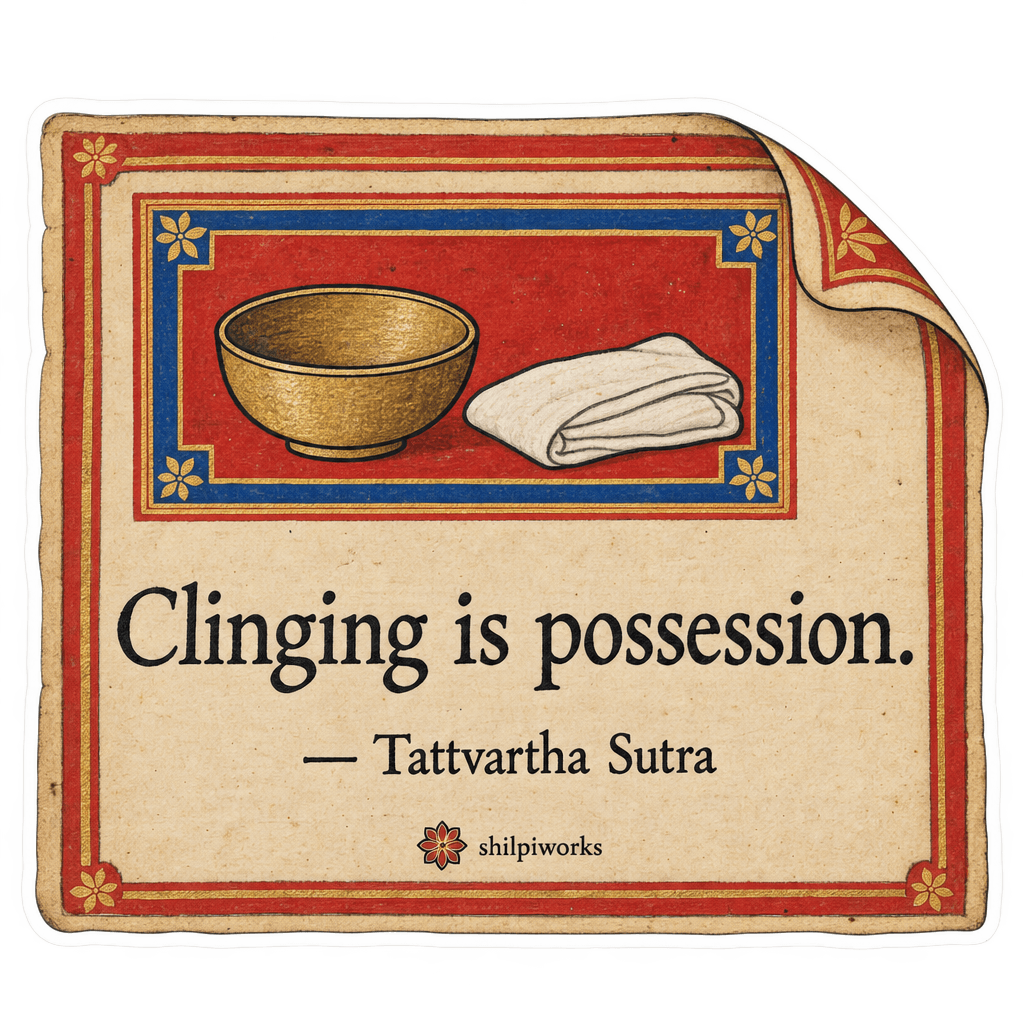
The Tattvartha Sutra defines possession as internal attachment.

extends to
Uttaradhyayana Sutra Jain Self Mastery Manuscript
Nami's reply when the same visitor urges him to conquer kings.

contrasts with
Soul Companion Jain Wisdom
Looking inward for shelter once worldly ties are severed.