Cell Biology · Lesson 11 of 12
Mitosis
A photocopy machine spits out a duplicate of a signed sheet. Now two people have the exact same list of instructions on two separate pages. If one copy dropped a paragraph, someone wouldn't know what to do. One cell dividing into two works under the same strict rule. When your body makes a new skin cell or gut cell, the new cell needs an identical set of DNA instructions. It can't guess what was there, and it can't run on half a set.
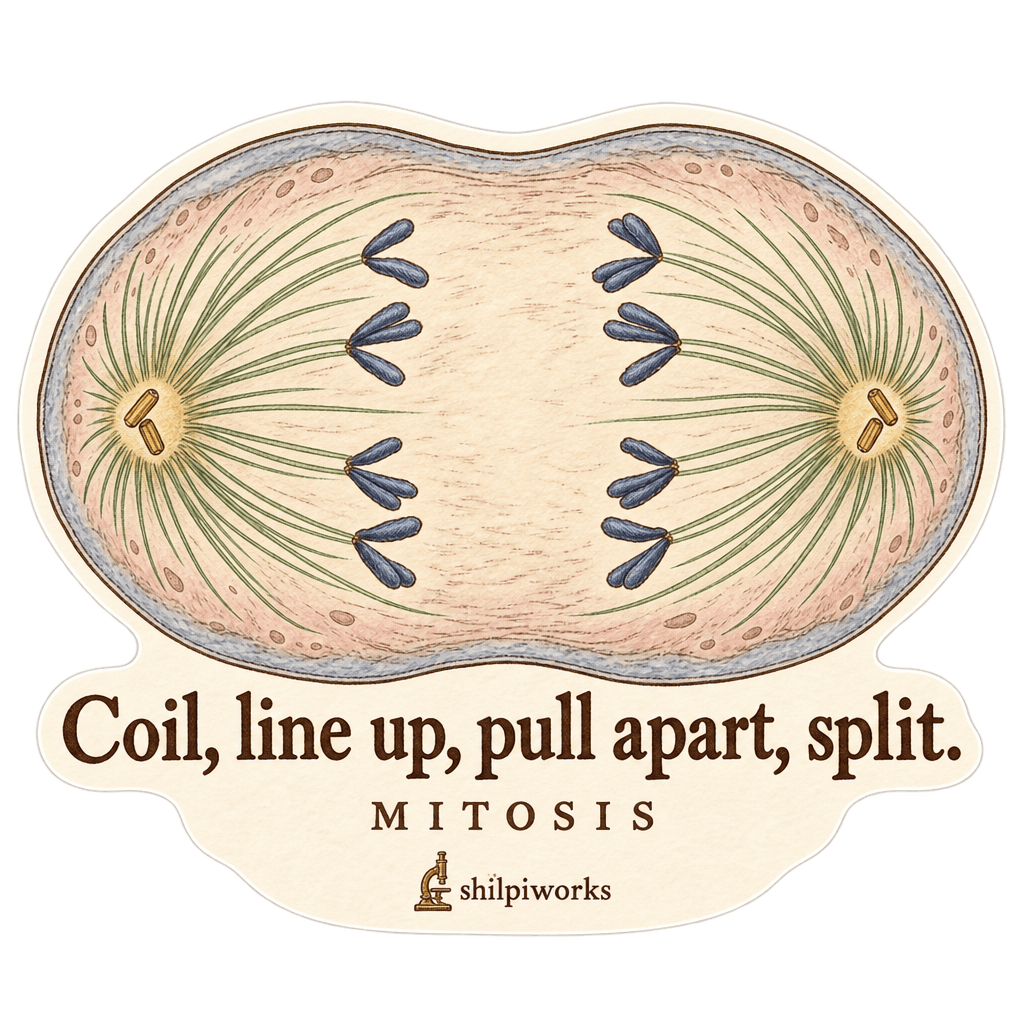
Mitosis is how a cell separates its DNA so two new cells end up identical. The memory line, "Coil, line up, pull apart, split", walks through the stages in order. First, the loose strands of DNA wind up tight into chromosomes. Next, those chromosomes line up across the middle of the cell. Tiny fibres pull the matching halves apart to opposite ends, and two new nuclei form. But the four words make it sound like four stop-and-start steps. In a living cell, it's one continuous motion from start to finish. The cell copies its DNA long before any coiling begins, and the final pinching of the cell in two has its own name, cytokinesis.
Therefore
Watch for the idea that cells pause between stages. The names are labels people invented so they could talk about one smooth dance.
Walther Flemming, 1882
Walther Flemming was a professor of anatomy in Kiel, Germany. In the late 1870s, he wanted to see how cells divide. He chose fire salamander larvae because their cells have unusually large nuclei. Flemming used synthetic aniline dyes to stain the cells, and the dyes colored threads inside the nucleus. He named that material chromatin. Under his microscope, he watched the threads split down their length into two identical halves. In 1882, he published his drawings in a book and named the process mitosis, from the Greek word for thread. He showed that every new nucleus comes from an existing one.
A small reminder, on a notebook or a desk, that every cell in your body came from a single cell copying and dividing.
$3.50
2.5 inches vinyl · weatherproof · ships in 1–3 days
Mix & save: 3 for $9 · 5 for $14 · 10 for $25· free shipping at ten
- Weatherproof vinyl
- Ships from Wayzata in 1–3 business days
- Secure checkout
If anything is wrong, we'll refund or replace it. Read the policy
Related patterns
pairs with
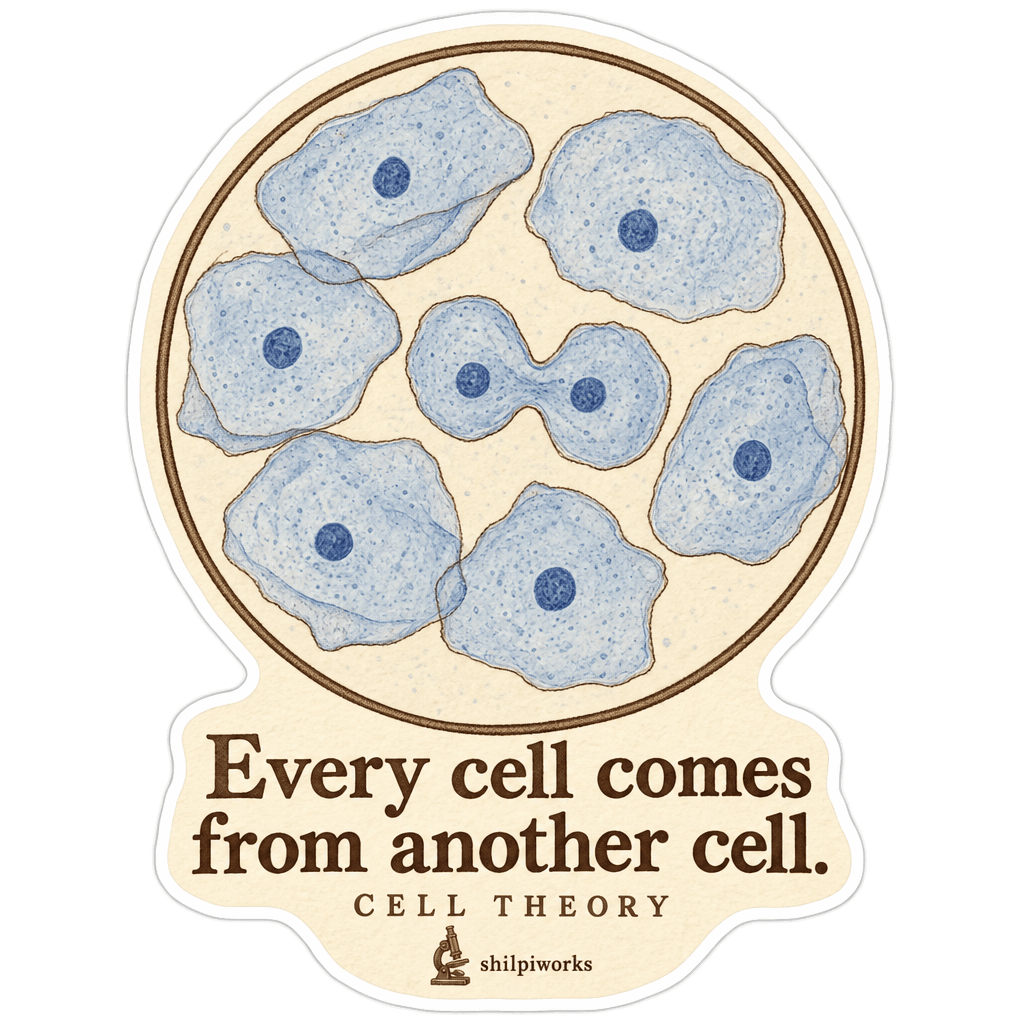
Cell Theory — Every Cell Comes From Another Cell
Mitosis is the physical way one cell gives rise to another.
pairs with
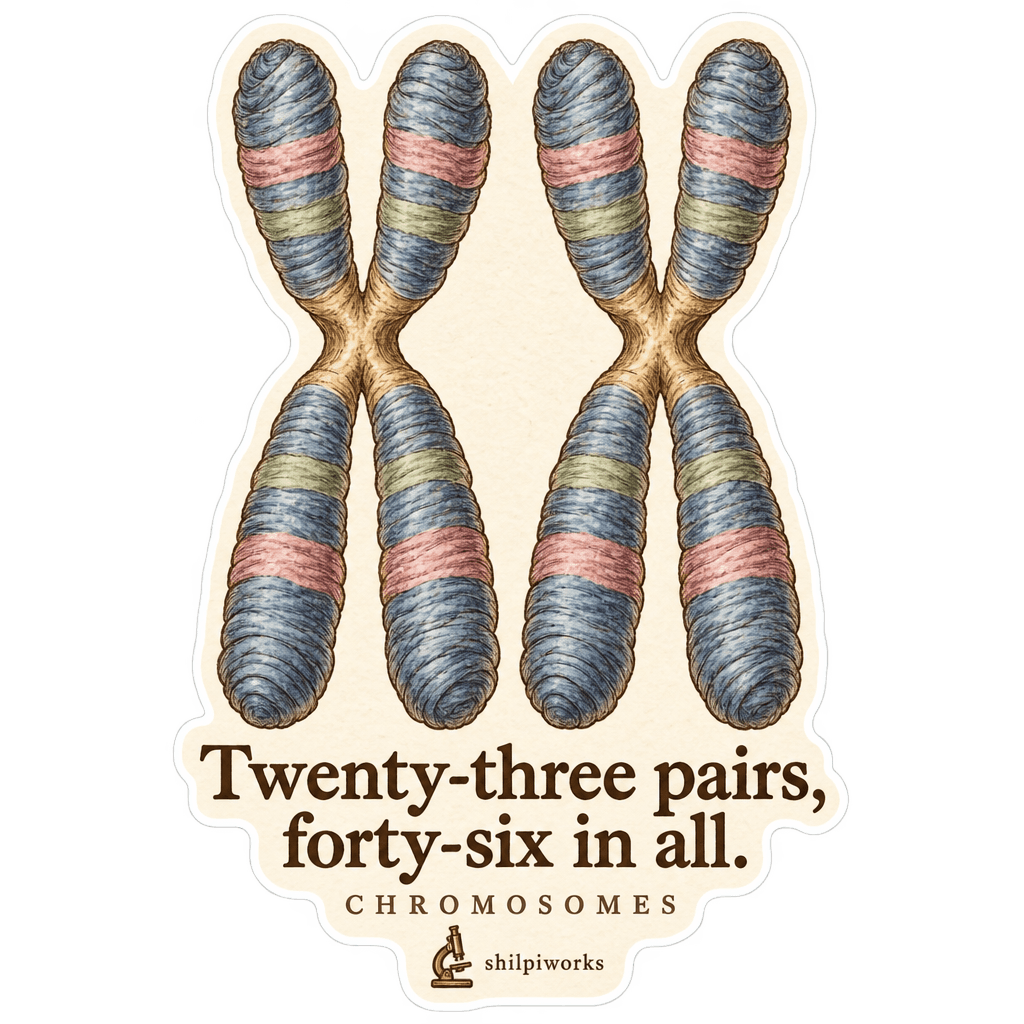
Chromosomes — Twenty-Three Pairs, Forty-Six in All
These are the coiled DNA packages that split during mitosis.
extends to
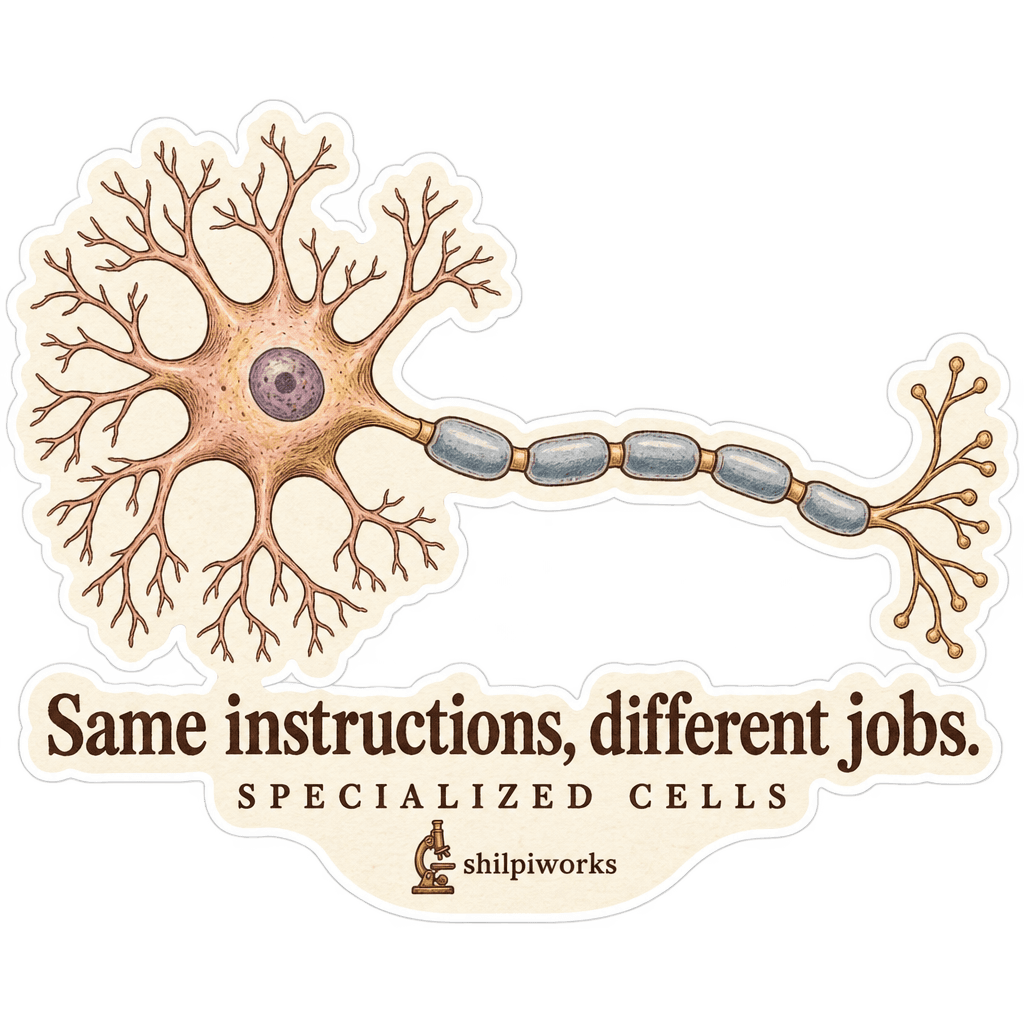
Specialized Cells — Same Instructions, Different Jobs
Mitosis gives every cell the same DNA, but cells specialize later.