Chromosomes
A family photo album sits open on the kitchen table. You have your father's chin and your mother's eyes, and those traits came from physical packages inside you. Inside almost every cell in your body, your DNA is wound up into bundles called chromosomes. They work like matched volumes of an instruction set. You get one set of twenty-three from your mother and one set of twenty-three from your father. Together they make forty-six.
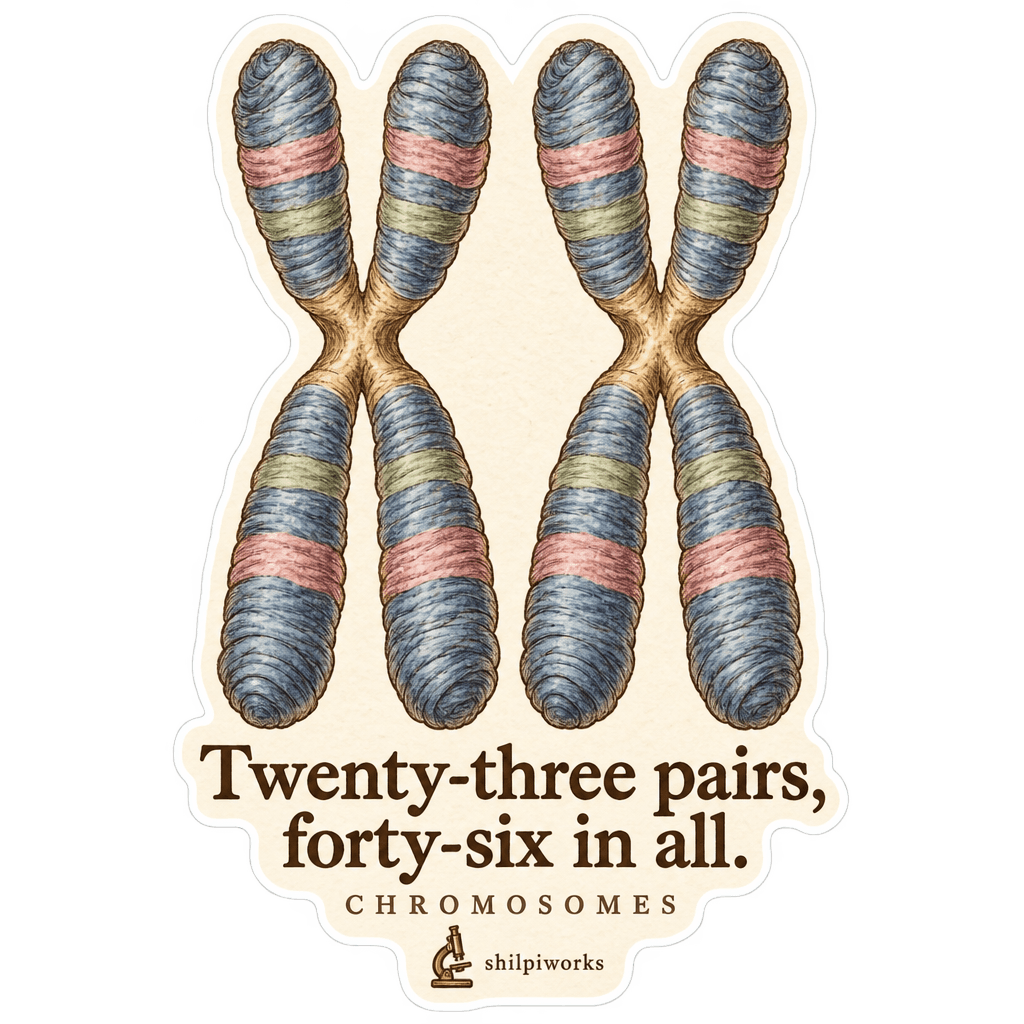
A single chromosome is just one long strand of DNA, wrapped tightly around proteins so it doesn't tangle. The classic X shape only shows up right before a cell divides, after it has already copied its DNA. People learn the phrase "Twenty-three pairs, forty-six in all," but that count doesn't hold for every cell. Egg and sperm cells carry only twenty-three, so a new baby starts with the right total instead of double. Mature red blood cells push out their chromosomes entirely as they grow up, leaving them with zero. Some people are born with forty-seven chromosomes, which happens in Down syndrome when a cell keeps three copies of chromosome 21. Even the twenty-third pair isn't always matched, because in men the Y chromosome is much smaller than the X.
Therefore
Treat forty-six as the standard baseline for human cells, but don't expect nature to be completely uniform. Watch how different cells drop, halve, or change those chromosomes to do their jobs.
Joe Hin Tjio, 1955
For over thirty years, biology textbooks taught that human cells had forty-eight chromosomes. Theophilus Painter had counted forty-eight in 1923 at the University of Texas, and nobody questioned his count. In late December 1955, Joe Hin Tjio was working alone at the University of Lund in Sweden while his lab head was away for Christmas. Tjio was preparing lung cells from human embryos. He soaked the cells briefly in a weak salt solution to swell them and spread the chromosomes apart. When he looked through his microscope, he didn't find forty-eight. In every undamaged cell, he counted forty-six. He and Albert Levan published the new count in 1956.
A small reminder, on a binder or a laptop, that forty-six tightly coiled strands hold the blueprint for making you.
$3.50
2.5 inches vinyl · weatherproof · ships in 1–3 days
Mix & save: 3 for $9 · 5 for $14 · 10 for $25· free shipping at ten
- Weatherproof vinyl
- Ships from Wayzata in 1–3 business days
- Secure checkout
If anything is wrong, we'll refund or replace it. Read the policy
Related patterns
pairs with
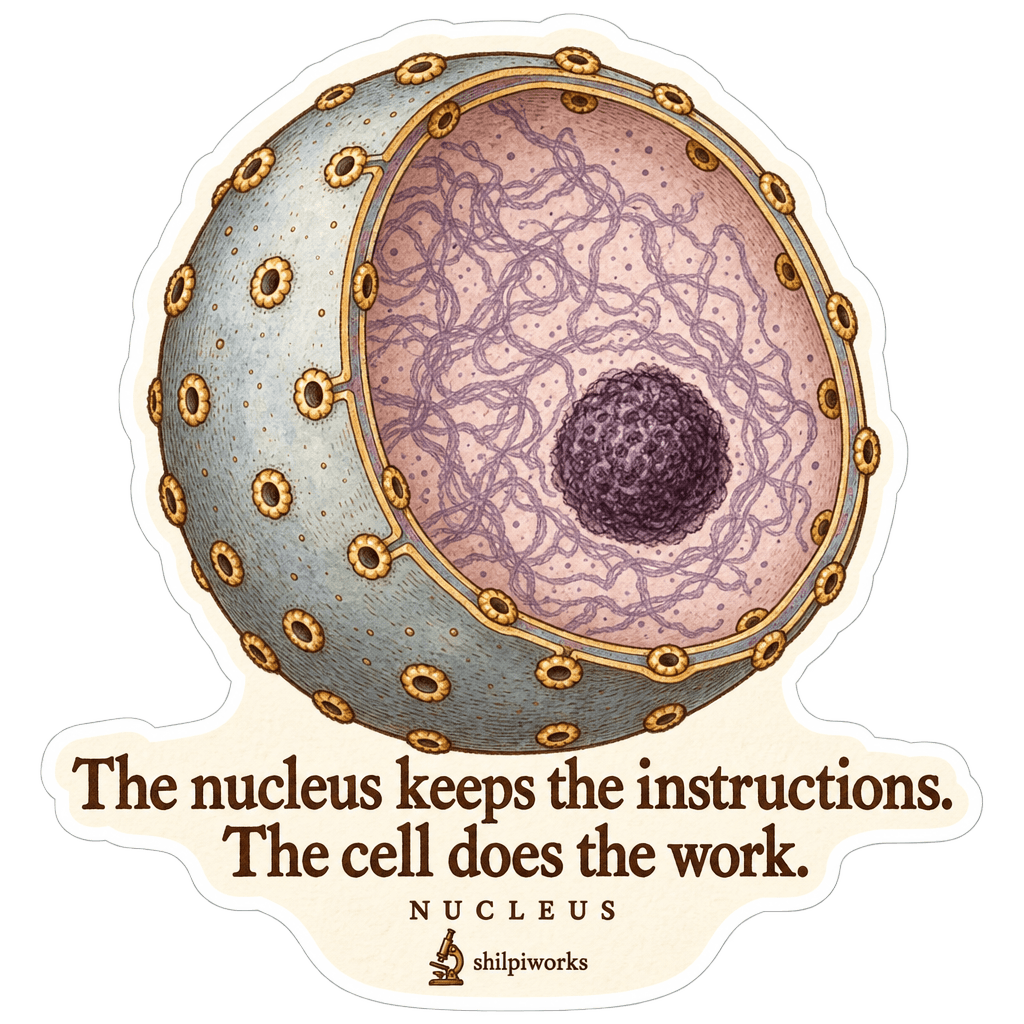
Nucleus — Where the Instructions Are Kept
Chromosomes live inside the nucleus, protected by its double membrane.
extends to
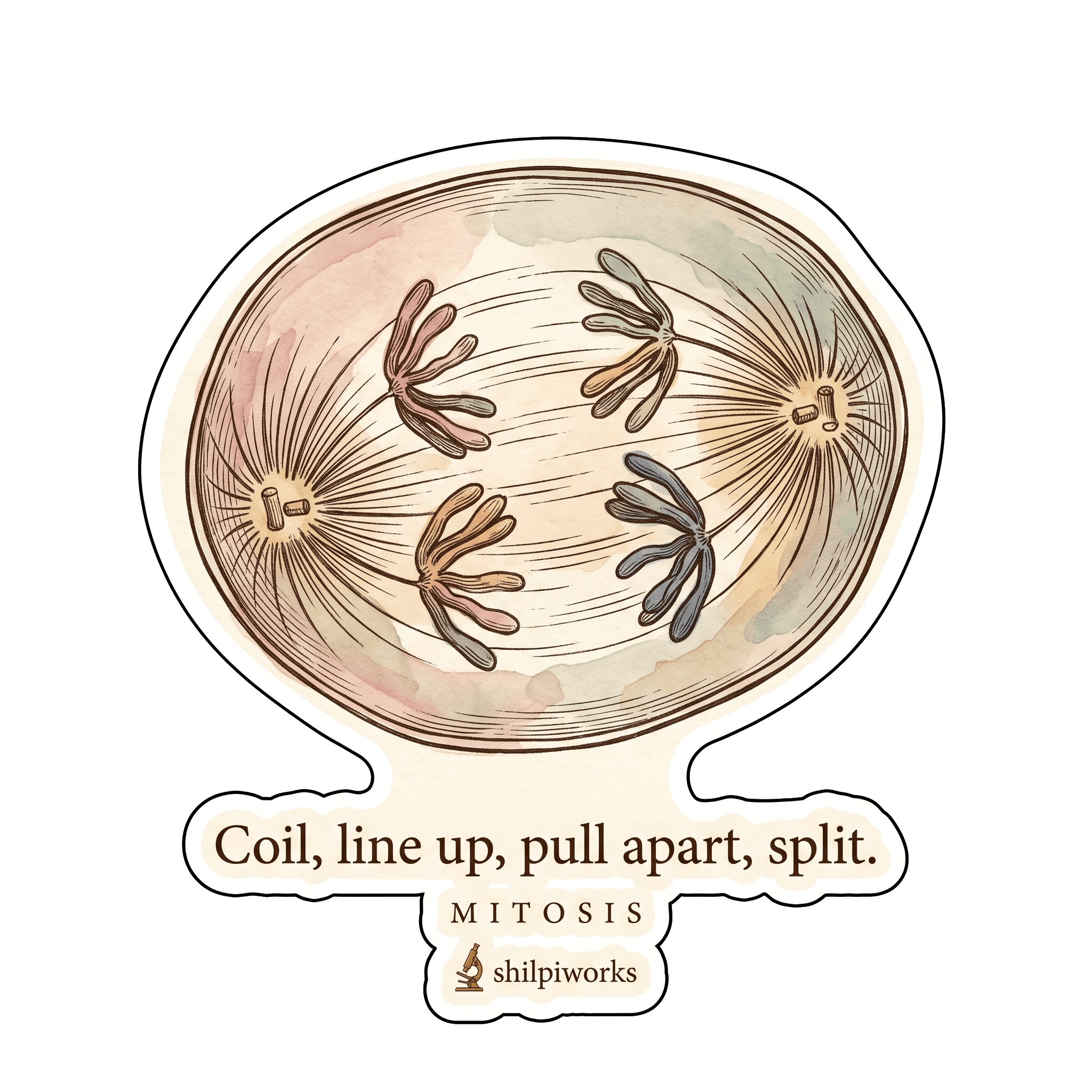
Mitosis — Coil, Line Up, Pull Apart, Split
Chromosomes coil into their X shapes so the cell can divide them evenly.
contrasts with
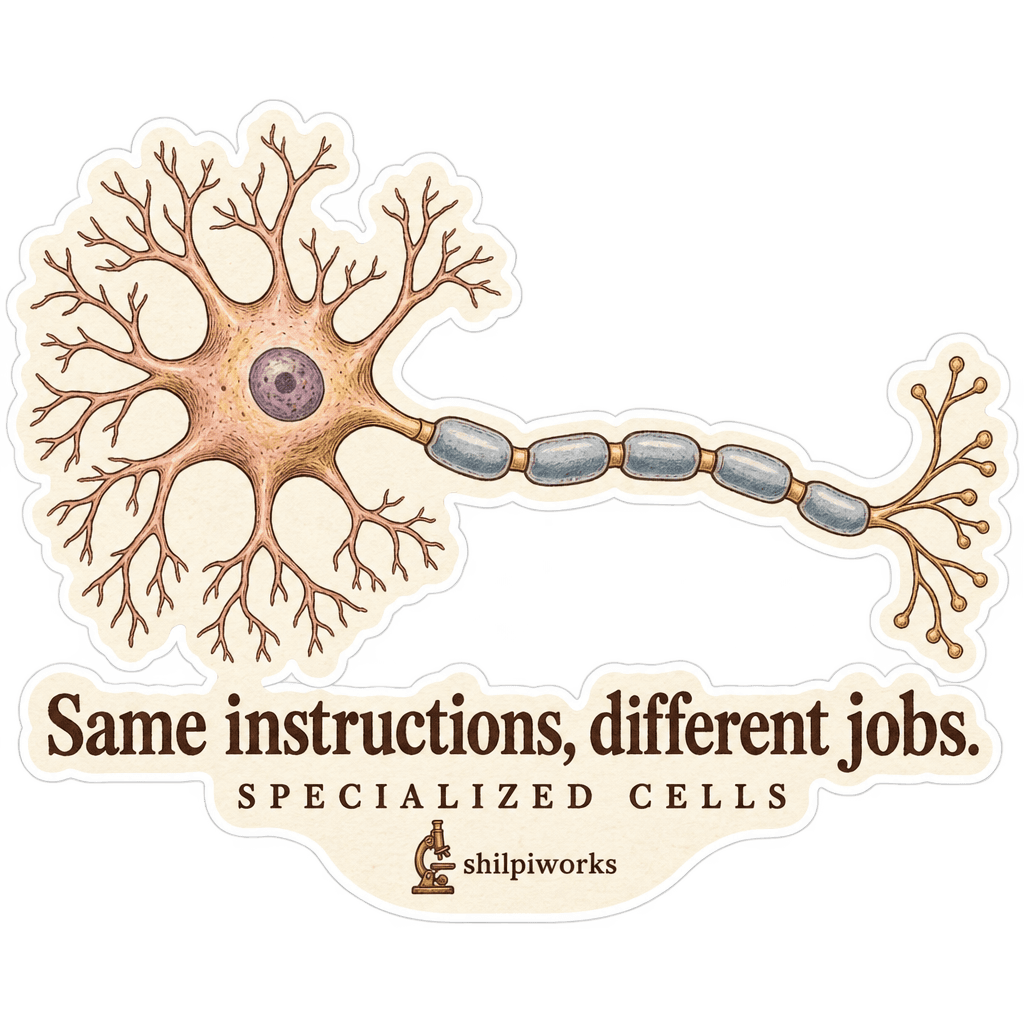
Specialized Cells — Same Instructions, Different Jobs
Every cell carries the same forty-six chromosomes, but uses different genes.