Veil of Ignorance
It's budget season at work. The team has to rewrite the bonus policy and the leave rules. You could be the manager next year, or you could be the new hire who just moved for the job. Nobody knows. You all start listing edge cases: a sick parent, a star performer, a slow quarter. Then someone says, close your eyes and pick at random which badge you will wear after the policy is set. Would you still like the same rules if you turned out to be the lowest paid one? The room gets quiet, and lines are erased.
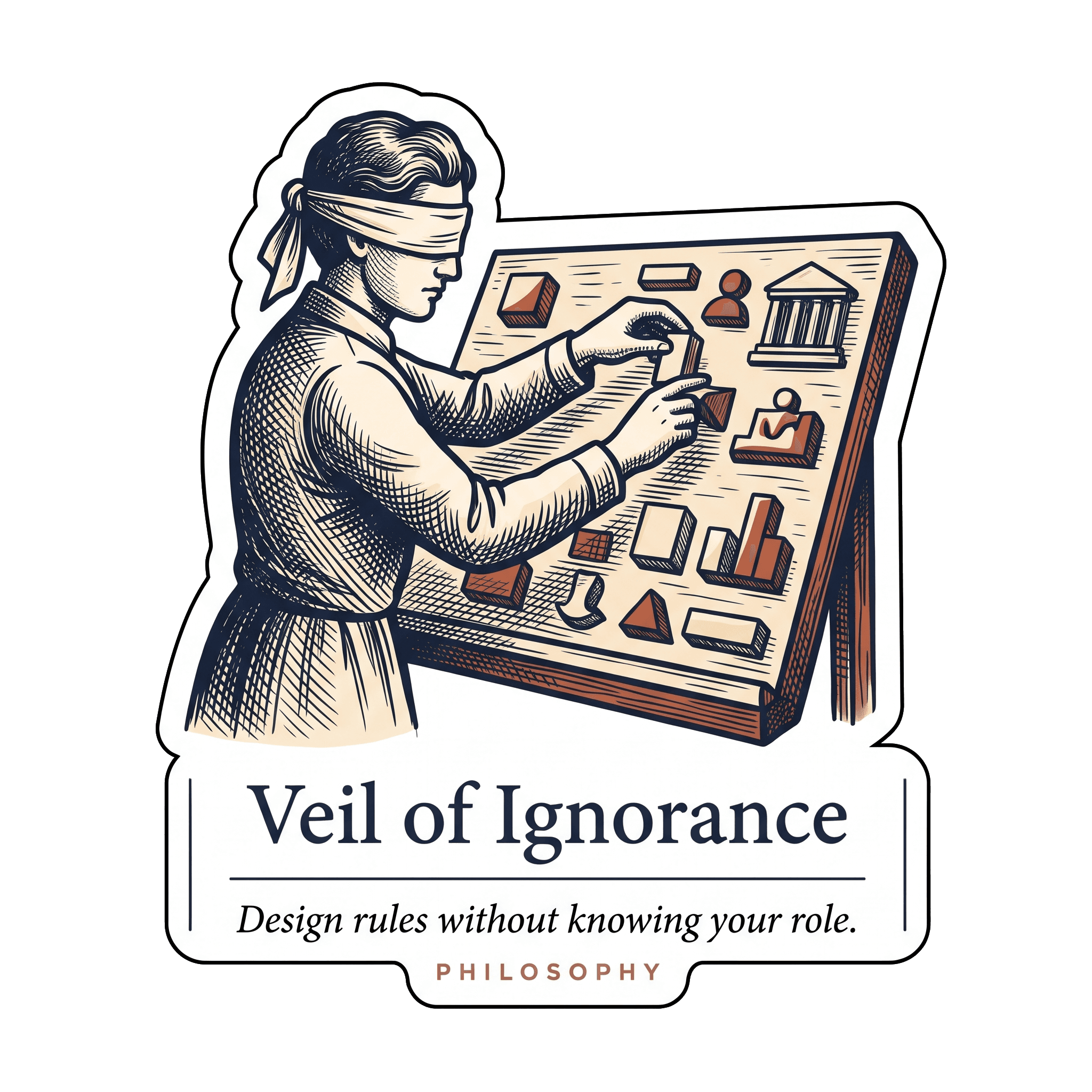
That move is the veil of ignorance. You design rules as if you did not know where you will land. It shifts your attention from your current badge to the spread of outcomes. You stop writing a policy that only fits the winner, and you look at the worst seat too. Most people then pick systems that allow upside but protect the bottom. Chore charts, tax brackets, and grading curves all change when you might be the person with the least power.
Therefore
When you set a rule, close your eyes and randomize your role. If you would not accept it from the worst seat, rewrite it until you would.
Frohlich & Oppenheimer, 1990
Norman Frohlich and Joe Oppenheimer ran a series of lab sessions in 1990. Small groups had to choose a rule to divide money that would be earned in a later task. The catch was that each person’s rank in the later task would be set by lottery after the rule was chosen. So you could end up rich or poor under the rule you picked. Over and over, groups did not choose strict equality or winner-take-all. They chose a rule that maximized the average payout while guaranteeing a floor for the worst-off. Facing the blind draw changed what felt fair.
A small reminder, on a policy draft or a chore chart, that fairness shows up fastest when you could be anyone at the table.
$3.50
2.5 inches vinyl · weatherproof · ships in 1–3 days
Mix & save: 3 for $9 · 5 for $14 · 10 for $25· free shipping at ten
- Weatherproof vinyl
- Ships from Wayzata in 1–3 business days
- Secure checkout
If anything is wrong, we'll refund or replace it. Read the policy
The artwork is made with AI image tools, by agents we design and check. Each sticker is then printed on vinyl and die-cut to order.