Orbit Rings
After dinner you step outside with a jacket and a phone alarm. The app says the space station will pass in two minutes. You scan the sky and find a bright point sliding in a steady arc. It moves faster than any star and keeps a clean path until it fades into Earth’s shadow. Tomorrow it comes a little earlier and takes a slightly shifted route. You start to expect the curve. You begin to see that the sky has lanes, and things keep to them.
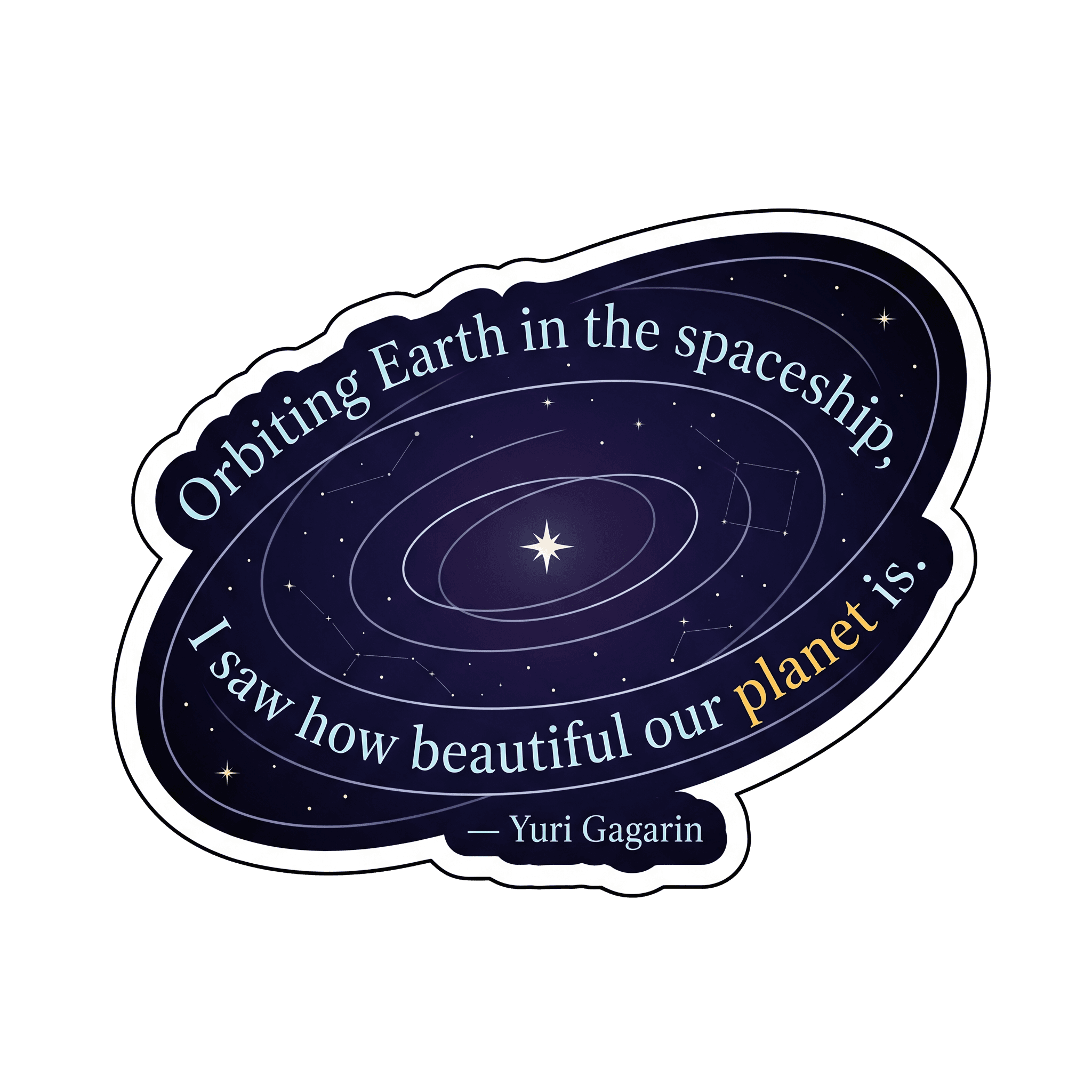
An orbit is a path made when motion and gravity balance. Left alone, a spacecraft or a moon would travel straight, but gravity bends that path into a loop. Most of those loops are ellipses, like the nested ovals around a bright center here. Objects speed up near the close end of the ellipse and slow down far away. We track these paths by watching against the fixed patterns of constellations, timing repeats, and fitting an ellipse that matches the stops and starts we record.
Therefore
Pick one moving target and watch it night after night. Mark where it appears against the constellations, and let the path reveal itself.
Johannes Kepler, 1609
Kepler spent years with Tycho Brahe’s careful measurements of Mars and tried to make them fit a circle. The numbers would not behave. He nudged the center, stretched the shape, and finally tried an ellipse with the Sun at one focus. The errors vanished. He also saw that Mars swept out equal areas in equal times, which meant it moved faster when it was closer to the Sun and slower when it was farther. He did this without a telescope, just positions plotted over many nights. The simple oval explained a planet’s wandering and gave us a way to predict every loop.
A small reminder, on a telescope log or a laptop lid, that clean sky rings appear when gravity and steady watching work together.
$3.50
2.5 inches vinyl · weatherproof · ships in 1–3 days
Mix & save: 3 for $9 · 5 for $14 · 10 for $25· free shipping at ten
- Weatherproof vinyl
- Ships from Wayzata in 1–3 business days
- Secure checkout
If anything is wrong, we'll refund or replace it. Read the policy
The artwork is made with AI image tools, by agents we design and check. Each sticker is then printed on vinyl and die-cut to order.