Red Queen
You get on a treadmill after work. The console glows a few feet ahead. You start to run. The belt hums and slides the other way under your shoes. Your legs burn and your breath shortens, and the console is still right there. A runner beside you matches your pace and goes nowhere too. You both did real work and did not change your place at all. You step off a little steadier, but your location has not moved an inch.
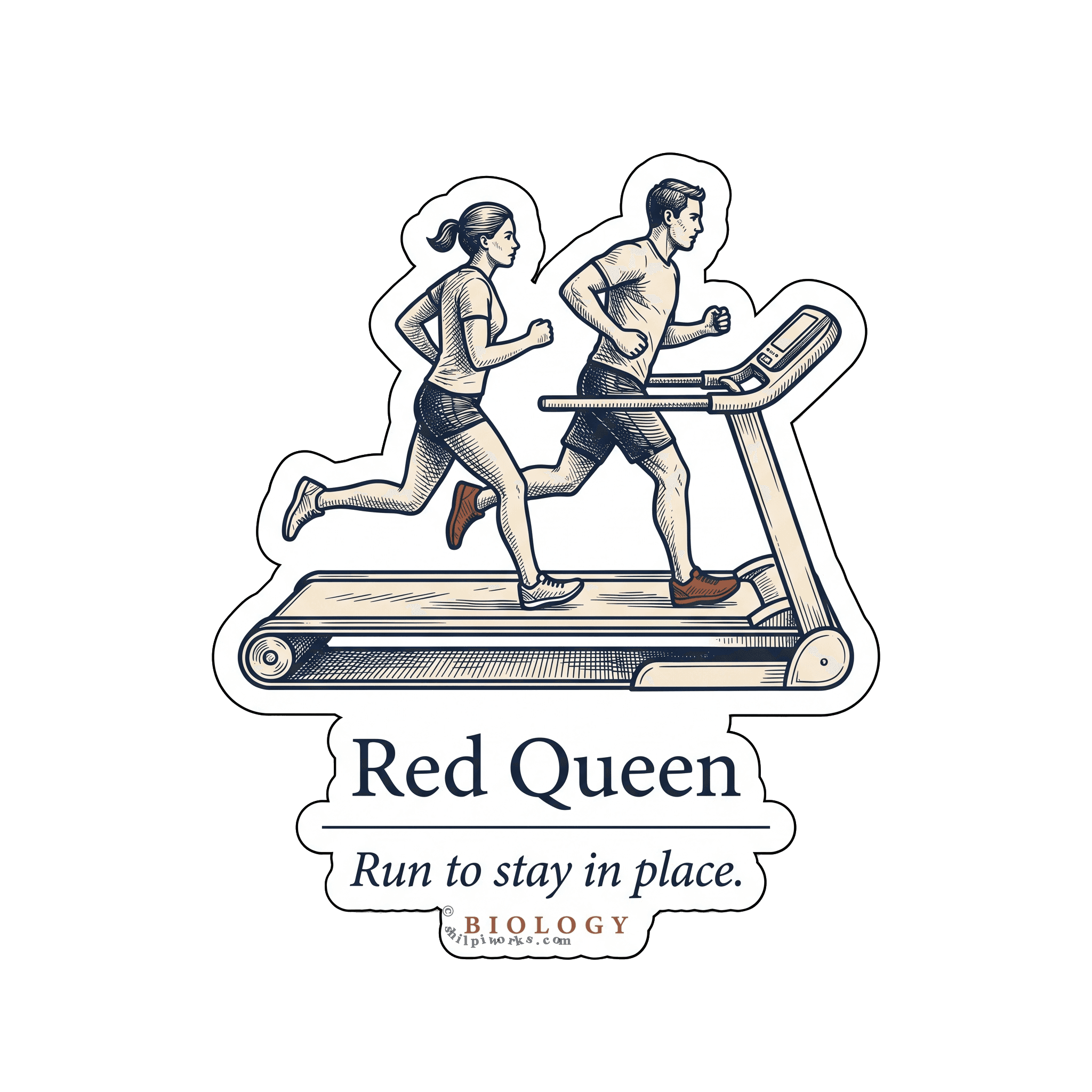
Biology runs on this same pattern. Every species has rivals, parasites, and changing weather, and all of them move. Pathogens mutate and our immune systems update. Farmers spray a pesticide and the surviving insects breed resistance. Search engines fight spammers, and then the spammers change their tricks. If one side slows, the other side catches up and wins. So steady effort only keeps you level, and extra effort is what moves you ahead.
Therefore
Budget for motion just to hold your ground. Treat updates, training, and patches as rent you owe, not as a one-time project.
Leigh Van Valen, 1973
Leigh Van Valen, a paleontologist at the University of Chicago, published a short paper in 1973. He graphed fossil data from many animal groups and asked a simple question: does a genus get safer the longer it has survived? The answer was no. The chance of extinction stayed about the same each year, whether a lineage was young or old. He argued that this could only happen because predators, prey, parasites, and climate were all moving targets. Species had to keep adapting just to hold their place. He named the idea after the Red Queen in Alice, who runs hard and stays put.
A small reminder, on a laptop lid or a lab notebook, that today's sprint keeps your spot, and tomorrow will ask for another lap.
$3.50
2.5 inches vinyl · weatherproof · ships in 1–3 days
Mix & save: 3 for $9 · 5 for $14 · 10 for $25· free shipping at ten
- Weatherproof vinyl
- Ships from Wayzata in 1–3 business days
- Secure checkout
If anything is wrong, we'll refund or replace it. Read the policy