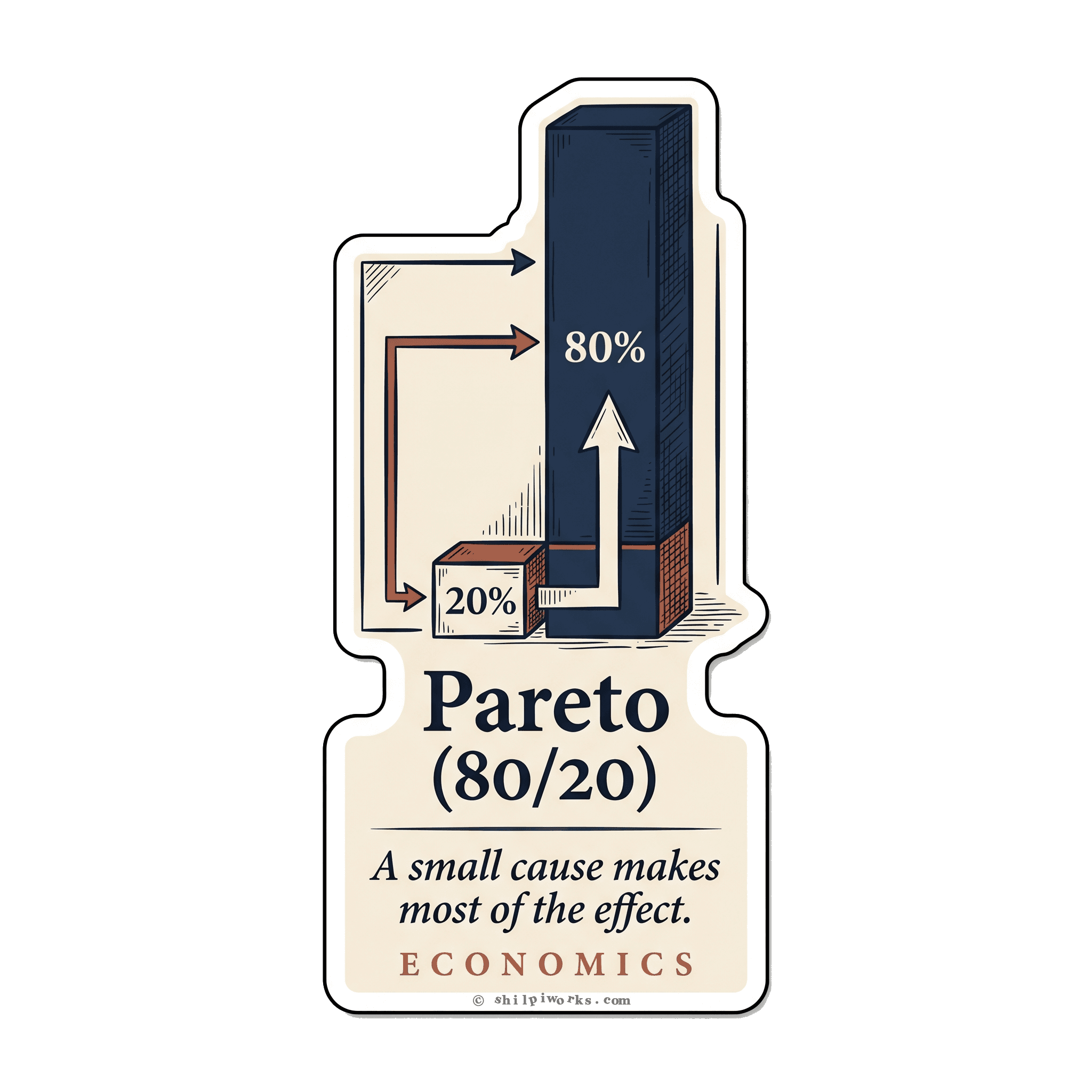
Power Laws
You send out a newsletter each week. Most issues get a handful of clicks. One old piece keeps pulling half your new signups every month. You tweak subject lines on the rest and see tiny bumps. Then a blogger links that one piece and your chart looks silly: a tall spike and a long flat line. You feel torn. Should you chase the spike or fix the rest? You are seeing how the world often works. Attention does not spread evenly. It piles up.
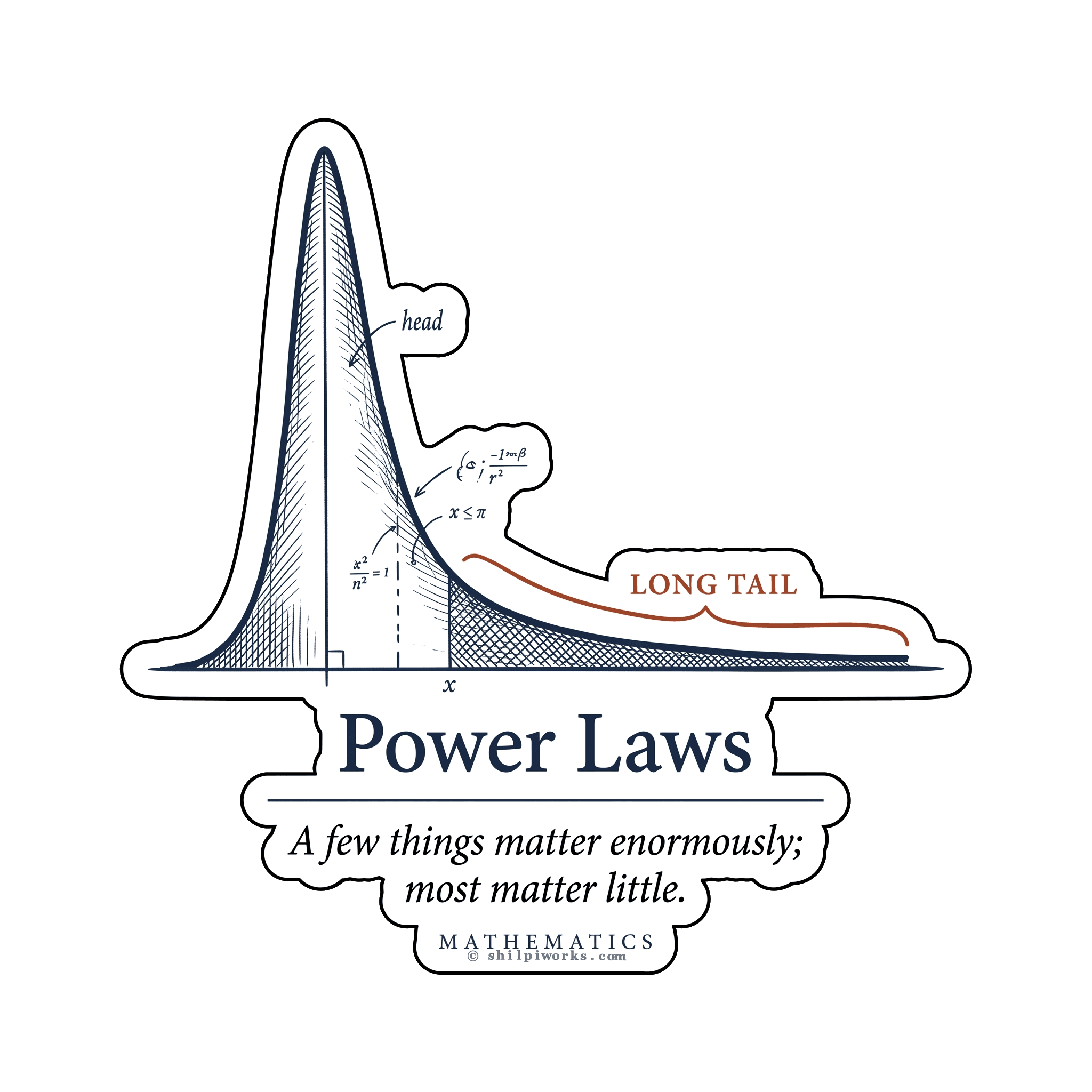
In many systems a few items get most of the action. We call this a power law. The tall part of the curve is the head, where the winners live. The long bracketed tail holds thousands of tiny contributions that add up slowly. That little note 'head' by the spike and the bracket marked LONG TAIL are the point. Hits, city sizes, followings, and startup returns all look like this.
Therefore
Expect most tries to do little and a few to carry the result. Make many small, cheap attempts, and double down fast when one starts to run.
Zipf, 1949
George Kingsley Zipf, a linguist at Harvard in 1949, sat with stacks of books and a mechanical counter. He counted how often each word appeared. When he ranked the words, he saw a pattern. The most common word showed up about twice as often as the second, three times as often as the third, and so on. On log paper the counts fell on a clean straight line. Different authors and languages produced the same shape. A few words carry most of what we say, and a very long tail of rare words fills in the rest. That is a power law.
A small reminder, on a dashboard or a whiteboard, that a few spikes will carry you, and most attempts will sit quietly in the long tail.
$3.50
2.5 inches vinyl · weatherproof · ships in 1–3 days
Mix & save: 3 for $9 · 5 for $14 · 10 for $25· free shipping at ten
- Weatherproof vinyl
- Ships from Wayzata in 1–3 business days
- Secure checkout
If anything is wrong, we'll refund or replace it. Read the policy