Physics
Inertia
The dolly's wheels clatter when you tip the refrigerator off the stoop. It rolls, heavy and sure, across the smooth garage floor. You see the gap closing with the doorframe and reach to yank the handle sideways. The strap bites your palm; the fridge barely shears a few inches, still sailing forward on its first thought. A pencil skitters off the workbench as it passes; your boot slides; the steel tongue of the dolly keeps pointing straight ahead while your small redirection merely curls around it.
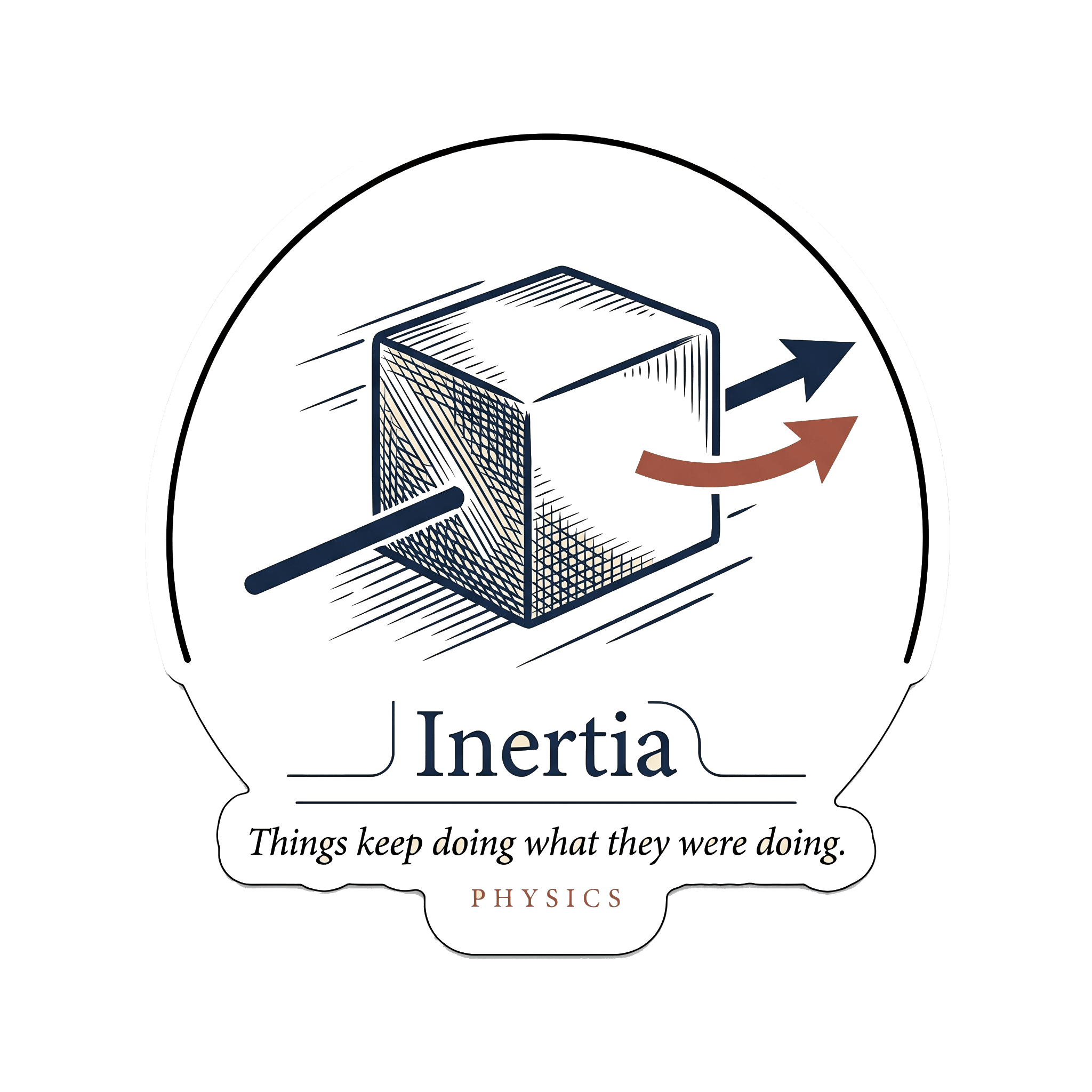
Inertia is the stubborn part of matter. Start at rest and it resists moving; start it moving and it resists turning or stopping. A hockey puck on black ice does not drift because nothing is asking it to. On the bus, the driver brakes and your body keeps going until the pole, the seatback, or your knees make the argument. Nudge a heavy block sideways while it is already going forward and you get a shallow, compromised path: the straight push inside it wins.
Therefore
To change a line already drawn, bring time or force. Either steer with it over distance, or commit to the stop that resets the frame.
Galileo, 1632
In Dialogue Concerning the Two Chief World Systems (1632), Galileo asked readers to walk belowdecks on a ship sailing smoothly. Open a bottle; watch the drops fall straight into the neck. Toss a ball to a companion; it comes back as if the room were still. Climb the mast and drop a stone: it lands at the foot of the mast, not trailing behind. The ship’s horizontal motion rides inside every object on it. Years earlier in Padua, with balls and grooved wooden ramps, he watched motion continue longer as friction thinned. From ship and ramp he drew the same rule: nothing changes course unless something makes it.
Related patterns


A small reminder, on a whiteboard corner or a toolbox lid, that paths harden quickly and small side tugs seldom suffice.
$3.50
2.5 inches vinyl · weatherproof · ships in 1–3 days